



Best Knife for Carving Turkey: Five Types Compared
Five kinds of knife can carve a bird, and each cuts differently. This guide compares them, explains blade length and tip, and gives the carving steps from rest to the last slice.
What is the best knife for carving a turkey?
The best knife for carving turkey is a carving knife with 8 to 10 inches of blade and a pointed tip. The tip follows the joints and the thin blade slices instead of tearing. A sharp 8 inch chef knife does the job when you own no carving knife, and an electric knife is the once-a-year shortcut.
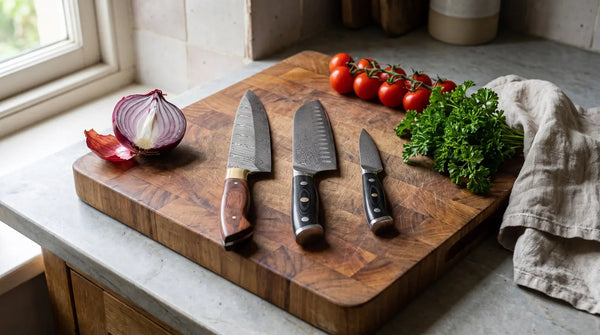
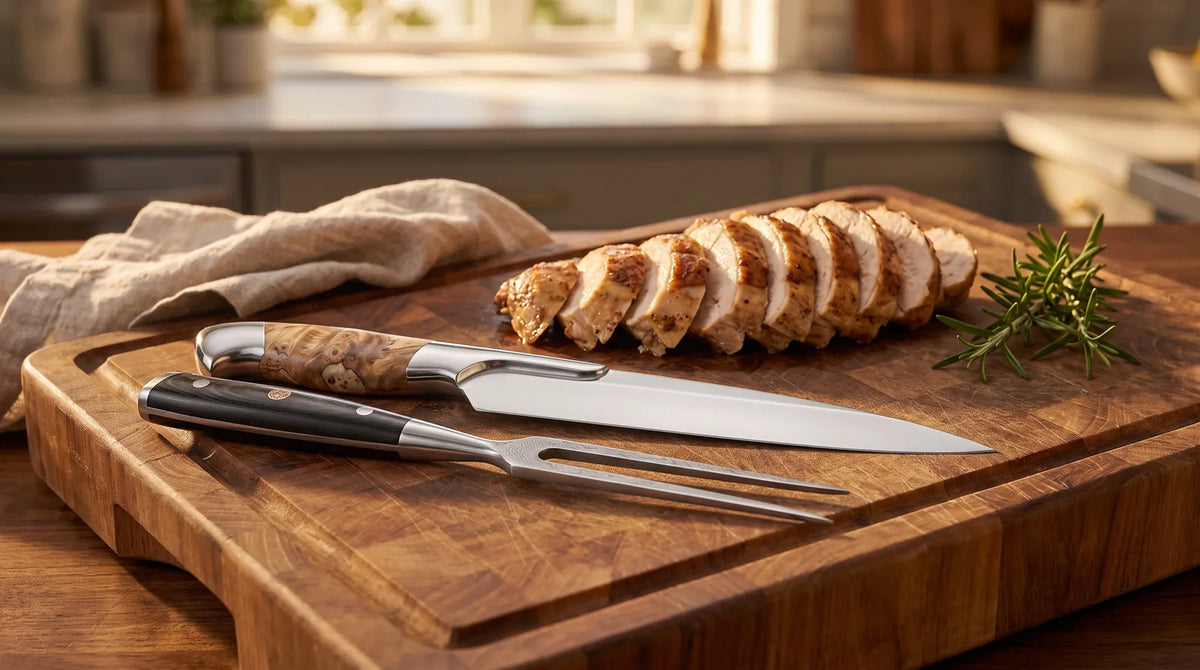
On October 24, 2026, the review sites we read (Serious Eats, America's Test Kitchen and Wirecutter) favor two brands for carving and slicing: Wusthof and Victorinox. We did not test their knives, so we say nothing about how they cut. Of our own knives, the 13" Satin Steel Carving Knife | Figured Burl has a 9.0 inch blade, and the Damascus Carving Knife and Fork Set | Micarta adds a matching fork. Both are in our carving knives collection.
Which carves a turkey best: carving, slicing, chef, boning or electric knife?
A carving knife carves a turkey best, and a sharp chef knife comes second. The table compares five kinds of knife on blade length, tip, strengths, weaknesses and who each suits. Blade lengths are typical ranges, not measurements of one knife, and our own lengths were read from our product pages on October 24, 2026.
| Knife | Blade length | Tip or edge | Does well | Does badly | Suits you if |
|---|---|---|---|---|---|
| Carving knife | 8 to 10 inches; ours include 9.0 | Pointed tip | Thin, even slices of breast; following a joint | Chopping and cutting through bone | You carve a few times a year |
| Slicing knife | 10 to 14 inches | Often a rounded tip | Long, even slices of boneless roast and ham | Joints and bone-in birds | You slice boneless meat more than whole birds |
| Chef knife | 8 to 10 inches; ours include 8.0 | Pointed tip | Joints, wings and breast, then every other kitchen job | Very thin slices: a wider, thicker blade drags | You own one good knife and want no second |
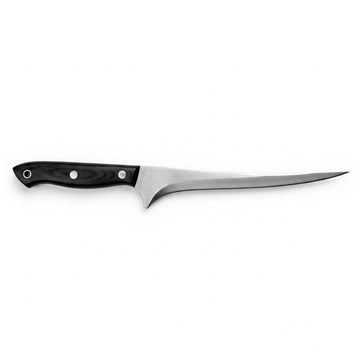
| Boning knife | 5 to 7 inches; ours include 6.0 and 6.5 | Pointed tip | Following joints and lifting meat off the bone | Slicing a whole breast: the blade is short | You already own a carving or chef knife |
| Electric knife | About 8 to 10 inches, by model | Twin serrated blades | Sawing through crisp skin and tough bits | Loud, usually needs an outlet, no thin slices | You carve once a year |
A carving knife wins on shape: its blade is thinner than a chef knife's, which reduces drag and gives even slices, and its point follows a joint or the breastbone. Our 8" Damascus Chef Knife | Walnut has an 8.0 inch blade, and the chef knives collection holds more at that length.
An electric knife saws through crisp skin and the tough bits, which suits someone who carves once a year. It is loud, it does not slice thin and most models need an outlet at the table. We sell no electric knife. Our guide to types of kitchen knives covers the rest of the family.
Is a slicing knife the same as a carving knife?
No, a slicing knife is not the same as a carving knife, though the two names overlap. A carving knife is the shorter of the two, usually 8 to 10 inches, with a pointed tip that works around bone. A slicing knife is longer, usually 10 to 14 inches, and often has a rounded tip for long strokes through boneless meat such as ham or a roast. Some makers use one shape for both names, so check the length and the tip, not the label.
A butcher knife is a different tool. Its blade is thick and heavy, built for raw meat and bone, where a carving knife is thin and built for meat that is already cooked.
What blade length and shape do you need for a whole bird?
For a whole turkey of 12 to 16 pounds, a carving knife needs a blade of 8 to 10 inches and a pointed tip. That length takes a breast half in a few long strokes and is short enough to steer at a joint. A shorter blade saws, and sawing tears the slices. A pointed tip follows the line of a joint or the breastbone, and a thin blade cuts a slice instead of wedging one. A carving fork holds the bird still while the tip works.
The 13" Satin Steel Carving Knife | Figured Burl has a 9.0 inch blade, which sits inside that range, and it is 13.0 inches overall with a figured burl handle.

How do you carve a turkey, step by step?
You carve a turkey in five moves: rest it, take off the legs and thighs, take off the wings, lift each breast half off the bone and slice it across the grain. Work on a large board with a juice groove, with the bird breast up.
| Step | What you do | Where the knife goes |
|---|---|---|
| 1. Rest | Leave the roasted turkey on the board for 20 to 30 minutes, longer for a very large bird. | Nowhere yet. Use the wait to check that the blade is sharp. |
| 2. Legs and thighs | Pull one leg away from the body. | Cut the skin between thigh and breast, press the leg out until the hip joint gives, then cut through the joint. Split drumstick from thigh at the joint between them. |
| 3. Wings | Pull each wing away from the body. | Cut through the joint where the wing meets the body. |
| 4. Breast off the bone | Steady the bird with a fork. | Cut straight down along one side of the breastbone, then follow the ribs with the tip until the breast half lifts away. |
| 5. Slice across the grain | Lay the breast half on the board, skin side up. | Cut across the grain, at a right angle to the long fibers, with long smooth strokes. |
The grain of a turkey breast runs lengthwise, so slicing across it shortens the fibers and gives tender slices.
Half a turkey: work the same steps on the one leg, one wing and one breast half you have.
Turkey in pieces: stop after step 4. You have two drumsticks, two thighs, two wings and two breast halves, and each piece can be cut smaller.
Is a carving set worth it, or is the knife enough?
A carving knife is enough to carve a turkey, but a carving fork makes the job steadier, and a set gives you both. The fork holds the bird still, keeps your free hand out of the blade's path and lifts slices onto the platter.
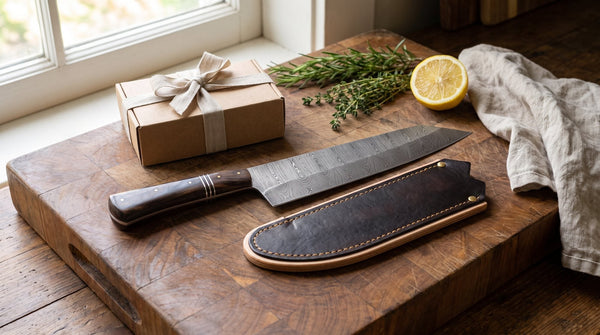
The Damascus Carving Knife and Fork Set | Micarta pairs a pattern-welded Damascus carving knife (1095 and 15N20) with its matching fork. Both have micarta handles and come in one leather knife roll at no extra cost, which makes the set the gift version. On October 24, 2026, the set cost $209 and the 13" Satin Steel Carving Knife, a knife only, cost $109.

The 13" Satin Steel Carving Knife | Figured Burl can be engraved on the blade or the blade guard, in text or a plain logo cut by machine, at the fee shown on its product page. Its burl handle takes no engraving. An engraved knife cannot be returned unless it arrives defective, and the refunds and returns page has the terms.
For more gift ideas, see gifts for cooks, kitchen knife sets and our guide to gifts for chefs.
What does a carving knife do the rest of the year, and how do you look after it?
A carving knife slices a ham, a roast of beef or pork and a brisket, so a knife bought for November works all year.
Wash the knife by hand and dry it at once. Our Damascus knives are pattern-welded 1095 and 15N20 and rust if left wet, and our satin steel carving knife needs the same wash and dry after the meal. Keep either knife out of the dishwasher, and put it back in its leather guard or roll only when it is dry. A stainless knife from another maker needs less care, and our guide to carbon steel vs stainless steel knives sets out the trade. The care guide covers the rest, and how to sharpen a knife has the steps for the edge.
Every knife we sell is hand-forged and made to order, and each product page shows when it will dispatch. Order early: our holiday order dates page lists the last days to order for Thanksgiving, which falls on Thursday, November 26, 2026.