



Types of Kitchen Knives and What Each One Does
A full table of the kitchen knives you will meet, from chef knife to nakiri, and an honest answer on which few a home kitchen needs.
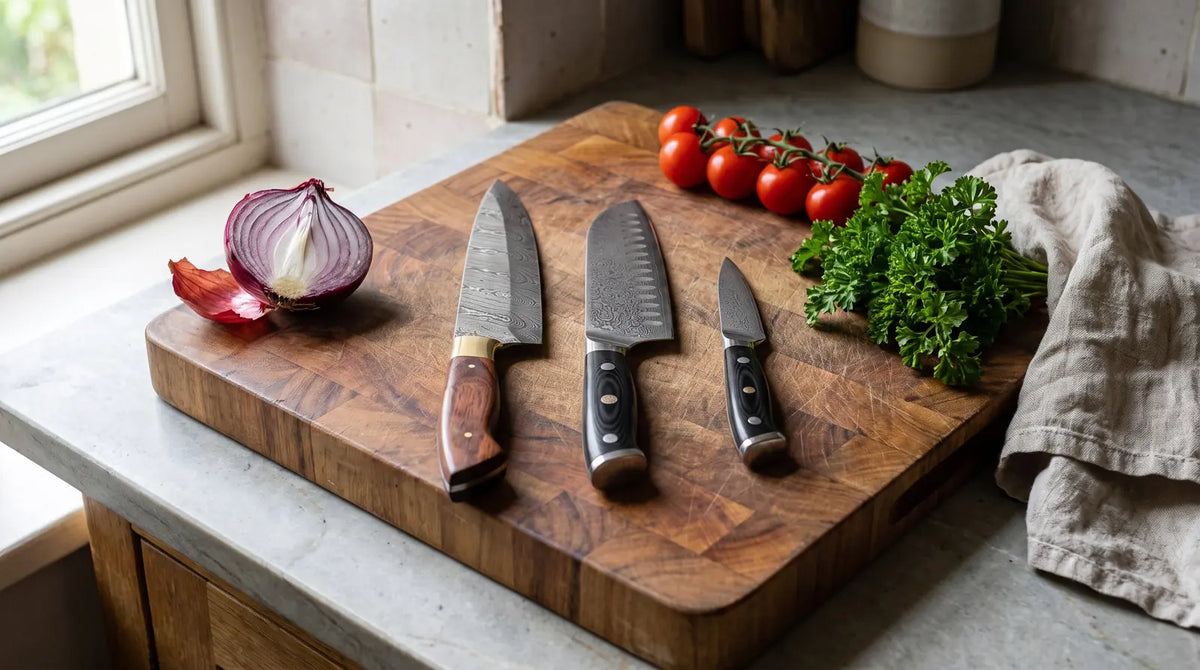
The common types of kitchen knives are the chef knife, santoku, kiritsuke, utility, paring, bread, boning, fillet, carving and steak knives, the meat cleaver, the Serbian chef knife and the nakiri. Most kitchens run on three: an 8 inch chef knife, a 3 to 4 inch paring knife and a serrated bread knife. The rest each do one job better.
What are the different types of kitchen knives?
Kitchen knives split into four families by job. General cutting knives (chef, santoku, kiritsuke, nakiri, utility, paring) handle vegetables, herbs and boneless meat. Bread and carving knives slice. Boning and fillet knives work around bone and skin. Cleavers and Serbian chef knives chop through heavier material, and steak knives sit on the table.
We forge most of these shapes. Our Damascus kitchen knives are pattern-welded 1095 and 15N20, which are carbon steels, so they need drying and a little oil. They are not stainless. The sections below name the job of each knife, then which ones a home kitchen needs.
The kitchen knife table: length, edge, best job and what to avoid
Typical blade lengths in this table are general kitchen knowledge, and they vary by maker. Where we make the knife, the second line of the length column gives the blade lengths recorded on our product pages as of October 8, 2026.
| Knife | Typical blade length | Edge | Best job | Not for |
|---|---|---|---|---|
| Chef knife | 8 to 10 in. Ours: 5.25 to 13 in | Straight with a curved belly | Rocking cuts on onions, herbs, vegetables and boneless meat | Bone, frozen food |
| Santoku | 5 to 7 in. Ours: 6 and 7 in | Nearly straight, rounded tip | Push cuts and thin slices of vegetables and fish | Heavy rocking, bone |
| Kiritsuke | 8 to 10 in. Ours: 7.25 and 8 in | Straight with an angled tip | Long slicing strokes through meat, fish and vegetables | Prying, bone |
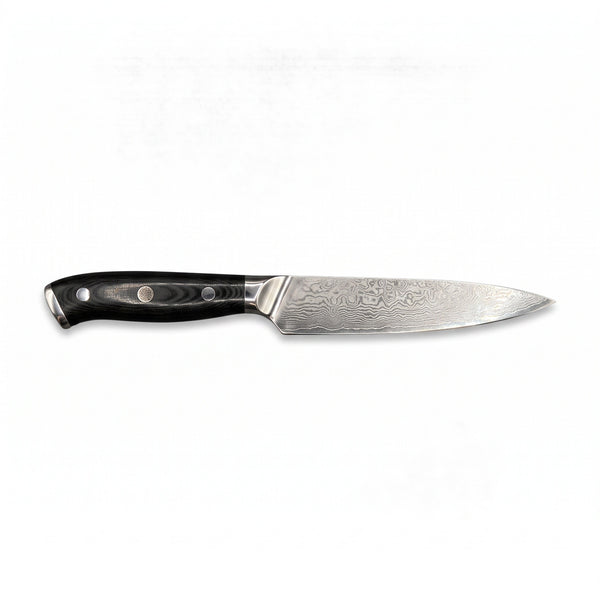
| Utility knife | 4 to 7 in. Ours: 5 and 6.3 in | Straight | Sandwiches, small fruit, trimming that suits neither a chef nor a paring knife | Large squash, bone |
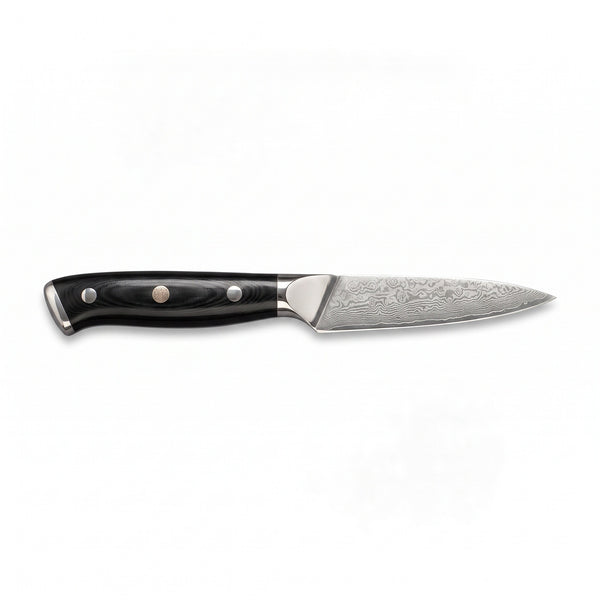
| Paring knife | 3 to 4 in. Ours: 3.5 in | Straight | Peeling, hulling, trimming in the hand | Chopping on the board |
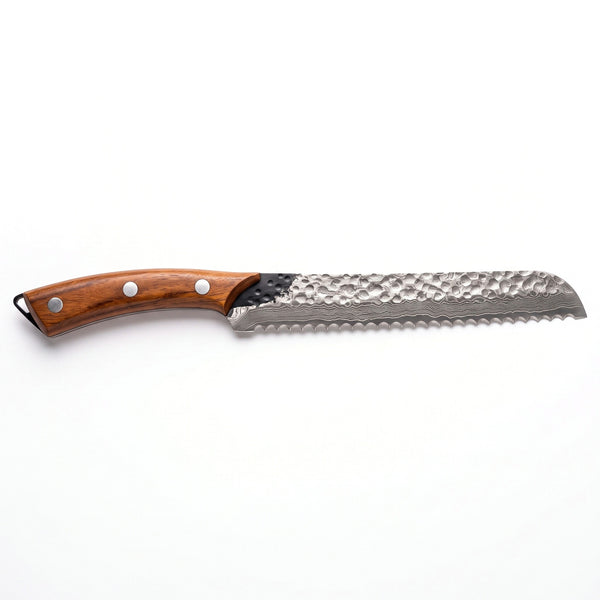
| Bread knife | 8 to 10 in. Ours: 8 in | Serrated | Crusty loaves, tomatoes, cake layers | Anything that needs a clean push cut |
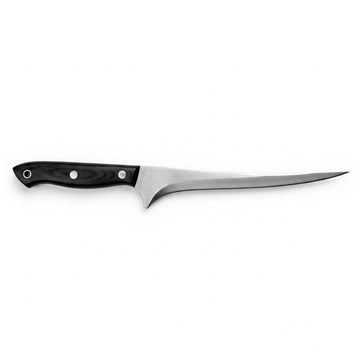
| Boning knife | 5 to 7 in. Ours: 6 and 6.5 in | Straight, narrow | Working meat off bone, trimming fat and silverskin | Cutting through bone |
| Fillet knife | 6 to 9 in. Ours: 6 and 7 in | Straight, flexible | Fish fillets and skinning | Hard vegetables, bone |
| Meat cleaver | 6 to 8 in. Ours: 6.5, 8 and 10 in | Straight, thick | Chopping ribs, joints and poultry bones | Fine slicing |
| Serbian chef knife | 6 to 8 in. Ours: 5.5 to 7 in | Straight with a curved belly, wide blade | Chopping, slicing and carrying food on the flat of the blade | Delicate peeling |
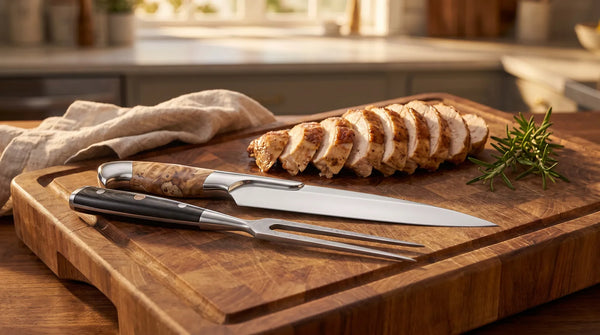
| Carving knife | 8 to 12 in | Straight, long, narrow | Thin slices of roast meat, with a carving fork to steady it | Chopping |
| Steak knife | 4 to 5 in. Ours: 4.25 in | Straight or serrated | Cutting cooked steak at the table | Prep work |
| Nakiri | 5.5 to 7 in | Straight, squared tip | Chopping vegetables flat against the board | Meat, bone |
What is the difference between a chef knife and a santoku?
A chef knife has a curved belly and a pointed tip, so you rock it on the board. A santoku has a nearly straight edge and a rounded tip, so you push it down and forward in a clean stroke. A chef knife suits cooks who chop fast and rock. A santoku suits cooks who like a shorter, lighter blade and thin, even slices.
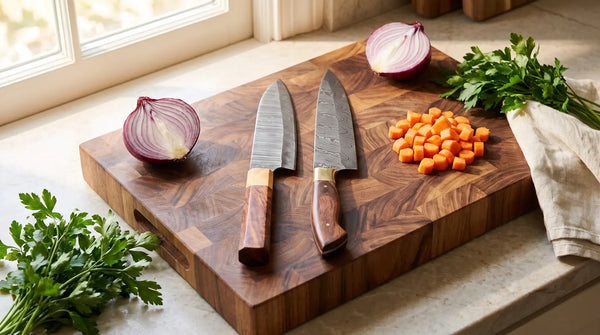
Our 8 inch Damascus chef knife with a walnut handle has an 8 inch blade, and our 7 inch Damascus santoku with a rosewood and olive wood handle has a 7 inch blade. Many cooks own both and pick by the task. This section is only the short version of a longer comparison.

What is a santoku knife used for?
A santoku is used for slicing, dicing and mincing vegetables, boneless meat and fish. The name means three virtues in Japanese, and cooks usually read that as those three cuts. Its flat edge and short blade make it easy to control, so it works well on a small board.
A santoku is a poor choice for bone and for hard rocking chops. Its flatter edge does not rock as freely as a chef knife does.
What is a kiritsuke, and what is a Serbian chef knife?
A kiritsuke is a long Japanese-style slicing knife with a flat edge and an angled tip, sold today as an all-round blade for meat, fish and vegetables. Our Damascus kiritsuke knives include an 8 inch kiritsuke with a reverse tanto tip.
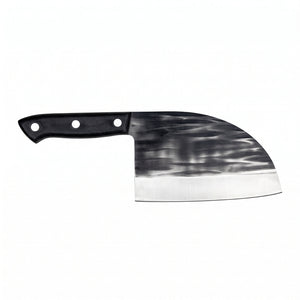
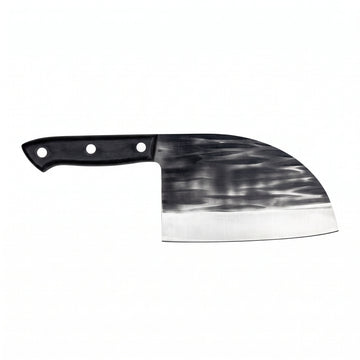
A Serbian chef knife is a wide, heavy blade with a curved belly, somewhere between a chef knife and a cleaver. You chop with it, slice with it, and scoop food off the board on its flat side. Our Hollow Serbian chef knives have blades of 5.5 to 7 inches, in Damascus and in forged carbon steel.
What kitchen knives does every kitchen need?
Every kitchen needs three knives: a chef knife of 8 inches or so, a paring knife of 3 to 4 inches and a serrated bread knife. Those three cover most of the cutting in a home kitchen. Professional cooks lean on the same trio, often adding a boning knife and a utility knife.
Add knives only when a job asks for them. If you break down chickens or trim roasts, add a boning knife. If you cook fish, add a fillet knife. If you chop through joints, add a meat cleaver. If you carve a holiday roast, add a carving knife and fork. A santoku, kiritsuke or nakiri is a matter of taste, not need.
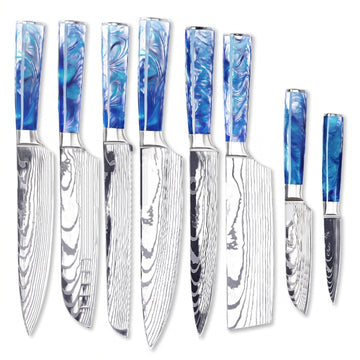
A set puts several of these in one place. Our Damascus kitchen knife sets run from 2 to 8 pieces, and a set ships in one Crownridge knife roll with a sewn slot for each knife. Our 5 piece Damascus kitchen knife set with rosewood handles is an example. You can browse Damascus knife sets or build your own from the Damascus chef knives.

Which steel suits kitchen knives: Damascus, carbon or stainless?
Kitchen knife steel is a trade between edge and upkeep. Carbon steel takes a keen edge and is easy to sharpen, but it rusts if left wet. Stainless steel needs less care and holds up better in a damp kitchen, though it can be harder to bring back to a fine edge. Which suits you depends on how willing you are to wipe a knife dry.
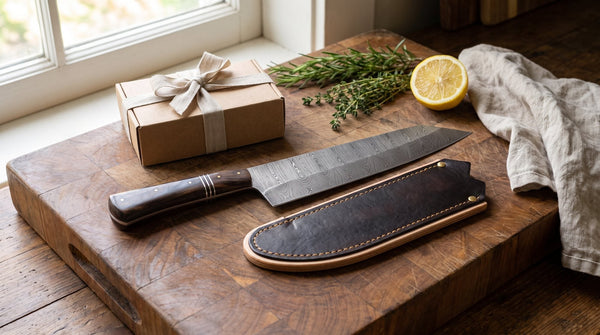
Our Damascus kitchen knives are pattern-welded 1095 and 15N20. Both are carbon steels, so a Damascus knife of ours must be dried after use and oiled now and then. Our forged carbon steel knives are single-steel and develop a patina with use. The full comparison is in carbon steel vs stainless steel knives, and the two Damascus steels are explained in 1095 and 15N20 steel.
Which kitchen knife handle material handles water best?
G10 and micarta handle water best, because both are resin-bonded and do not swell. Resin handles and pakkawood, which is wood sealed with resin, also tolerate a wet kitchen well. Plain hardwood, rosewood, walnut and olive wood look warm but can dry out or crack if they sit wet.
Our kitchen knives come with micarta, G10, resin, pakkawood and several hardwood handles. Whatever the handle, no kitchen knife should go in the dishwasher. The heat, the detergent and the knocking against other items dull the edge and damage handles.
How do you take care of kitchen knives?
You care for a kitchen knife by washing it by hand, drying it straight away and storing it in a guard, a roll or a magnetic strip. For carbon steel, wipe a thin film of food-safe oil on the blade if you will not use it for a while. Cut on a wood or plastic board, never on glass, stone or ceramic.
A honing rod straightens a lightly rolled edge between sharpenings, and a stone brings back a dull one. The steps are in how to sharpen a knife, and our care guide covers drying and oiling. Every kitchen knife of ours ships with a Crownridge leather blade guard at no extra cost, or in the roll if it is a set.

Meat cleavers, boning knives and more are in our cleavers and boning knives collection, and steak knife sets are in Damascus steak knives.
Are kitchen knives a good gift for a cook?
A kitchen knife is a good gift for a cook when it matches how they cook. A chef knife or a set suits someone who cooks daily, a carving set suits someone who hosts, and a boning or fillet knife suits someone who butchers or fishes. Pick the knife and not the grandest set.
Our gifts for cooks collection groups these together, and gifts for chefs goes through the choices. What each knife costs is shown on its own product page.