


Knife Care Guide
How to clean, oil, store and sharpen every knife we make, with care for each steel, handle material and piece of leather.
- Dry, then oilafter every use, on carbon steel and Damascus
- No dishwasherheat and detergent pit steel and crack handles
- Out of the sheathto store it; leather holds moisture on the blade
- Sharpen by handon a stone or rod; never a powered grinder
Dry the blade after every use, wipe a thin coat of oil onto carbon steel and Damascus, wash by hand and never in a dishwasher, and store the knife out of its sheath. Sharpen it by hand on a stone or a rod. Those two minutes prevent nearly every problem. The detail for each steel, handle and leather follows.
The two-minute routine after every use
- Rinse. Warm water and a drop of dish soap if there is grease or food on the blade. Wipe from the spine toward the edge, never along the edge.
- Dry it completely. Use a cloth or paper towel, and get into the joint where the blade meets the guard or bolster, where water hides.
- Oil it. Put two or three drops of oil on a cloth, wipe both faces of the blade, then buff until the steel looks dry. A thick coat only collects dust.
- Put it away dry. On a magnetic strip, in a block, in its blade guard or roll, or on a shelf, but not wet, and not in its sheath for more than a day or two.
Which oil: on a kitchen knife, food-safe mineral oil or camellia oil. On a hunting, camp or folding knife, mineral oil or any blade oil. Avoid olive oil and other cooking oils: they turn sticky and go rancid on the steel.
Care by steel
Every product page names its steel. Four of our five steels are carbon steels, and carbon steel rusts if it is left wet. That is the trade for steel that takes a keen edge and is easy to resharpen, and the routine above is the whole answer to it.
| Steel | Care |
|---|---|
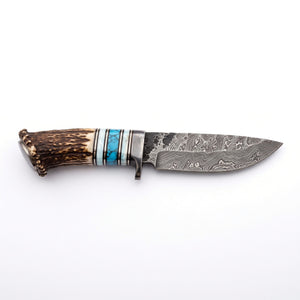
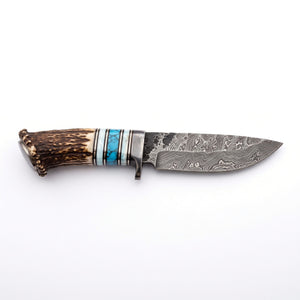
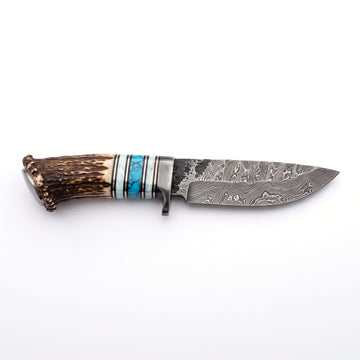
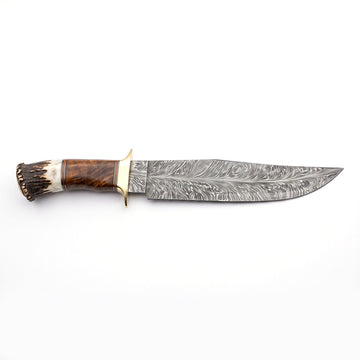
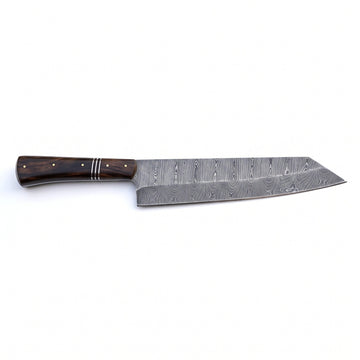
| Pattern-welded Damascus (1095 and 15N20) | Rusts if left wet. Dry and oil after every use. Never use steel wool, scouring pads or metal polish on the blade: they rub off the etch that makes the dark and bright layers show. |
| Forged carbon steel, satin finish | Rusts if left wet. Darkens to a gray patina with use, which is normal. Very fine steel wool is safe on this finish if rust appears. |
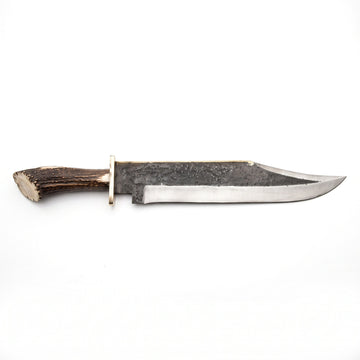
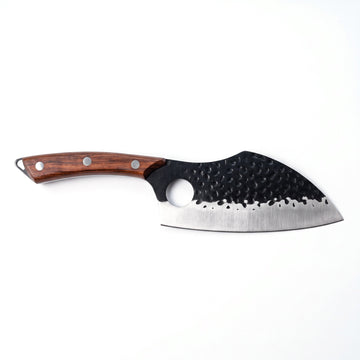
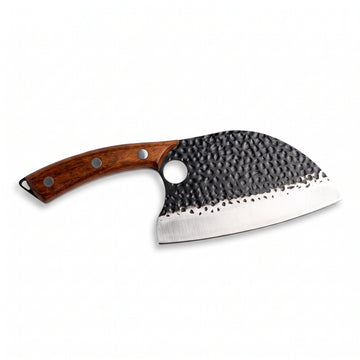
| Forged carbon steel, forge-scale finish | Rusts if left wet. The dark scale on the upper blade is part of the finish. Leave it alone; do not try to scrub it off. |
| Farrier rasp steel, forge finish | Rusts if left wet. Care as carbon steel. The rasp texture holds water, so dry it with extra attention. |
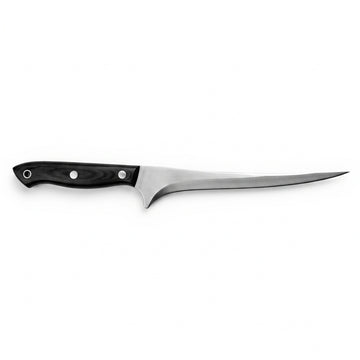
| J2 stainless steel, satin finish | Rarely rusts. The least care of any. Still wash and dry it by hand, and keep it out of the dishwasher. |
Patina: why carbon steel darkens
A carbon steel blade turns gray, blue-gray or patchy dark where it meets onions, citrus, tomatoes, meat and blood. That layer is a stable oxide, and it protects the steel from red rust rather than harming it. It is normal wear, not a defect. On Damascus it darkens the whole blade a little and softens the contrast between the layers; the pattern is still there.
Patina and rust look different. Patina is gray to black, smooth and even to the touch. Rust is orange or red-brown, sits on the surface, and feels rough. Patina stays; rust comes off, as below.
How to remove light rust
- On Damascus: a few drops of oil and a soft cloth, rubbed firmly over the spot. For a stubborn spot, a pencil eraser or a plastic (non-scratch) scrub pad with oil, light pressure only. No steel wool and no metal polish.
- On satin carbon steel and J2 stainless: oil and very fine steel wool (grade 0000), worked along the length of the blade, never across it.
- Afterwards: wipe the blade clean, dry it and oil it again.
Rust that has eaten small pits into the steel is past a home fix. Stop rubbing at it and email us with a photo. If the Damascus pattern looks faded after heavy cleaning, the pattern still runs through the steel and a re-etch brings it back; email us before you try one yourself, because the acid used for it is hazardous.
Handles, by material
Every product page names its handle. Find yours in the table; the same rule holds for every handle: never let it soak, and never leave it wet.
| Handle | Care |
|---|---|
| Natural woods: rosewood, walnut, olive wood, wenge, sycamore, snakewood, sandalwood, tali, vengai, mango wood, hornbeam, burl and other hardwoods | Towel dry right away. When the wood looks pale or dry, every month or two, rub in a few drops of food-safe mineral oil or a board wax and wipe off the excess. |
| Stabilized wood, pakka wood and dyed wood | Wood filled with resin, so water does not get in. Wipe clean; no oiling needed. |
| Stag, bone, camel bone and horn | Natural materials that crack when they soak or when they go from wet to hot. Towel off, let them air dry at room temperature, and keep them away from a stove or a heater. An occasional drop of mineral oil keeps them from drying out. |
| Mother of pearl and turquoise | Damaged by acids (lemon juice, vinegar) and by harsh cleaners, and they chip if knocked. Wipe with a damp cloth and dry. |
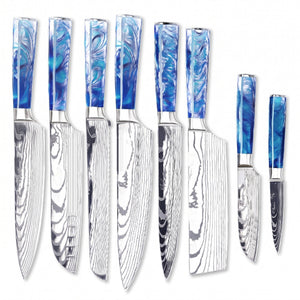
| Micarta, G10 and resin | Waterproof. Wipe clean with a damp cloth; no oil. Keep solvents such as acetone off resin, which dulls its shine. |
| Stacked leather, birch bark and cord wrap | Keep dry. If one gets wet, let it dry slowly at room temperature, never next to heat. Rub a little leather conditioner into stacked leather a few times a year. |
| Steel and brass handles, guards, bolsters and pins | Dry and oil steel with the blade. Brass darkens with handling, which is normal; brass polish brings the shine back, but keep polish off a Damascus blade. |
Kitchen knives
- Cut on wood or plastic. Glass, stone, marble, ceramic plates and metal trays chip and roll an edge in a single stroke.
- Keep to food. Bone and frozen food chip a thin kitchen edge, and they are outside normal use for our kitchen knives and cleavers alike, so they fall outside the warranty.
- Wipe acidic food off promptly. Tomato, citrus and onion left on carbon steel etch a patch within minutes.
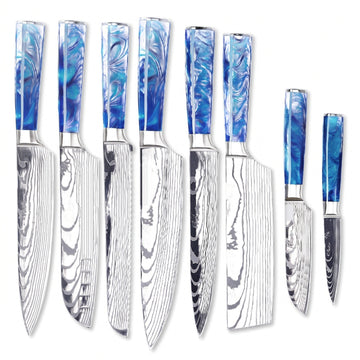
- Store the edge where nothing touches it: in the block that comes with a block set, on a magnetic strip (spine to the magnet, and lift the knife off rather than sliding it), or in its leather blade guard. Loose in a drawer, an edge chips against other utensils.
- Knife sets in a leather roll: dry every knife before it goes back in the roll, and leave the roll open to air for an hour if it gets damp.
Hunting and camp knives in the field
- Wipe blood and fat off as soon as you can. Blood is salty and starts rust on carbon steel within hours. A wipe with a rag or grass in the field, then a proper wash, dry and oil back at camp or home.
- Clean the gut hook. Hair and tissue collect in the hook. Clean it with a cloth or an old toothbrush, then dry and oil it.
- Batoning: splitting small wood by striking the spine of a camp knife or bowie with another piece of wood is normal use. Never strike the spine with metal, and never pry or twist with the blade.
- After rain or a river crossing: take the knife out of the sheath, dry and oil the knife, and dry the sheath separately.
Folding knives
- Once every few months, put one drop of oil at the pivot, open and close the blade a few times, and wipe off what comes out.
- If the action turns gritty, rinse the open knife under warm water, work the blade to flush out the grit, dry it thoroughly with the blade open, then oil the pivot.
- Close the blade with your fingers clear of the edge. Never pry with the blade or force the lock.
Hatchets, kukris and machetes
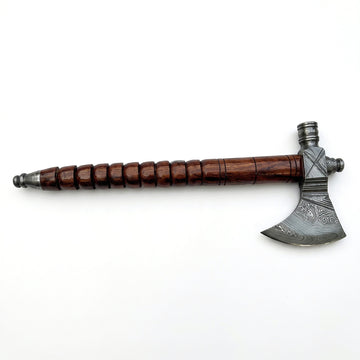
Dry and oil the head or blade after use, as with any carbon steel. Keep the leather head mask or sheath on for carrying and off for storage. A wooden handle that has dried out pale takes the same mineral oil as a wooden knife handle. Chopping, limbing and splitting wood are what these are for; prying a stuck head out of a log by levering the handle sideways is what breaks them.
Honing and sharpening
An edge dulls in two ways. First it rolls over, and a honing rod (ceramic or steel) stands it back up in five or six light strokes per side. In the kitchen, hone every few uses. When honing no longer brings the bite back, the edge has worn, and it needs a whetstone.
- Keep the angle already on the knife. Color the bevel with a marker, take a stroke on the stone, and look: if the ink is gone across the whole bevel, your angle matches. Adjust until it does.
- Grits: a 1000 grit stone for regular sharpening, a 3000 to 6000 grit stone to refine the edge, and a coarse stone (around 400) only to remove a chip.
- Serrated bread knives: a tapered ceramic rod, one scallop at a time, on the beveled side only, then one light pass on the flat side. A flat stone ruins the serrations.
- Gut hooks: a small tapered rod that fits the curve of the hook.
- On Damascus, the freshly sharpened bevel shows bright steel. That is normal; the etch is only on the surface, and the pattern still runs through the blade.
- Skip pull-through carbide sharpeners, which tear metal off unevenly, and never use a powered grinder or wheel: the heat ruins the temper, and that damage is not covered by the warranty. Sharpening by hand on a stone or a rod never affects it.
Sheath and leather care
Every knife comes with its leather: a belt sheath on a fixed blade, a belt slip on a folding knife, a blade guard on a kitchen knife, one roll for a set, and a head mask on a hatchet.
- Carry the knife in its leather; store it out of it. Leather holds moisture against the steel, and a blade left sheathed for weeks rusts even when the leather feels dry. It also absorbs oil from the blade over time, which is harmless.
- If the leather gets soaked, let it dry at room temperature, away from a heater, a fire or the sun. Heat shrinks and cracks wet leather.
- Condition it two or three times a year, or whenever it looks pale and dry, with a leather conditioner rubbed in by hand. That keeps the body and the stitching supple.
- Check the fit. A belt sheath should hold its knife when turned upside down. If dry leather has loosened its grip, conditioning brings it back.
Storing a knife for months
Wash it, dry it completely, and give the blade a slightly heavier coat of oil than usual. Store it out of its sheath, in a dry room, wrapped loosely in a dry cotton cloth if you like, but not sealed in a plastic bag or box, which traps damp air. Check it and wipe it over with oil once a month. A garage, a shed or a vehicle swings in temperature and humidity and is the worst place to keep one.
Quick answers
Can a Damascus knife go in the dishwasher?
No. Heat and detergent pit the steel, strip the etch, crack wooden and bone handles and ruin leather. Dishwasher damage is not covered by the warranty. This goes for J2 stainless too.
Will the Damascus pattern wear off?
No. The pattern runs through the steel, because it is two steels forge-welded together. Abrasives can rub off the surface etch that gives it contrast, and a re-etch restores it.
How often should I oil my knife?
After every wash, on carbon steel and Damascus, and once a month on a knife in storage. J2 stainless needs oil only if it will be stored for a long time.
How often should I sharpen it?
When honing stops bringing the edge back. For a kitchen knife in daily use, that is every few months; for a hunting knife, after a season or a few big jobs.
Is the gray color on my blade rust?
Gray, blue-gray or black that feels smooth is patina, and it protects the steel. Orange or red-brown that feels rough is rust; remove it as described above.
Care and the warranty
Our Limited Lifetime Warranty covers defects in materials and workmanship. It does not cover rust from storing a knife wet, in its sheath or without oil; damage from a dishwasher, soaking or heat; damage from a powered grinder or a repair someone else made; or normal wear such as patina, a dull edge and scuffs. Everything on this page keeps you inside it. For the steels and handles in the range and how we check every knife before it ships, see the spec standard, and to tell real Damascus from etched or printed imitations, see real vs fake Damascus.