


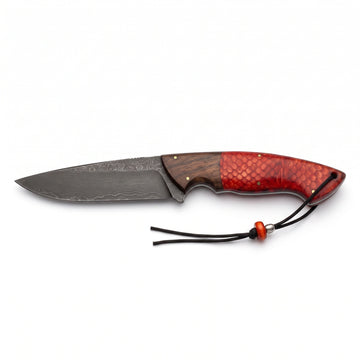
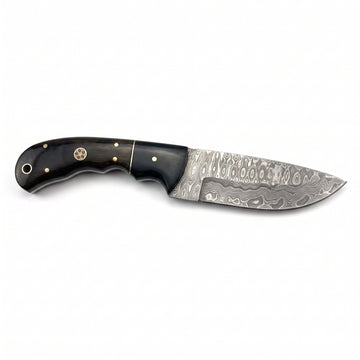
Real vs Fake Damascus
What pattern-welded Damascus is, how fakes are made, and six checks that tell them apart, with what we state about our own blades.
- Through the steelreal layers run spine to edge; a fake sits on the surface
- Check the spinepattern-welded layers show across the top of the blade
- Never repeatstwo knives with the same pattern line for line are fakes
- 1095 + 15N20the two steels in every Crownridge Damascus blade
Real Damascus is pattern-welded steel: two steels forge-welded into one bar, worked into a pattern under the hammer, then etched so the pattern shows. The layers run through the whole blade. A fake is plain steel with a pattern laser-marked, stenciled or printed on its surface. The spine, the edge and photos of several knives tell them apart.
Real and fake at a glance
| Check | Real pattern-welded Damascus | Fake surface pattern |
|---|---|---|
| The spine | The layers show as fine lines across the top of the blade | Bare, polished steel, or a pattern that does not line up with the sides |
| The pattern at the edge | Runs down into the edge bevel; a fresh sharpening leaves bright steel that shows the pattern again once it darkens or is etched | Stops at the edge bevel, or wears away with the first few sharpenings |
| Photos of several knives | Every knife's pattern is different | Two or more knives with the same pattern, line for line |
| The listing | Names the two steels, such as 1095 and 15N20 | Says only "Damascus steel", or names one steel |
| After years of sharpening | The pattern is still there; there is more of it underneath | Fades, then disappears |
| Price | Above a plain-steel knife of the same size from the same maker | Close to a plain-steel knife, because that is what it is |
What real Damascus is
Modern Damascus is made by forge-welding. A smith stacks alternating layers of two steels, heats the stack until the layers fuse into one solid bar, then folds, twists or cuts and restacks that bar under the hammer. Each step multiplies the layers and moves them into a pattern. The finished blade is ground, heat treated, then dipped in acid.
The acid is what makes the pattern visible. The two steels react to it differently: in a 1095 and 15N20 blade, the 1095 turns dark gray and the 15N20, which carries about 2 percent nickel, stays bright. The pattern is not on the steel. It is the steel, cut through at whatever depth the grinder stopped.
Three kinds of genuine Damascus
- Full pattern-welded Damascus. The whole blade, edge included, is layered steel. This is what we make: 1095 and 15N20, carbon steels that need oil and drying to stay rust-free.
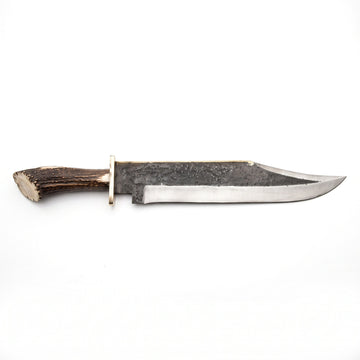
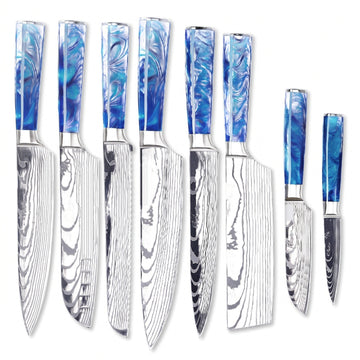
- Damascus-clad (san mai). Layered steel forge-welded over a core of a single harder steel, common on kitchen knives. The core shows as a plain, bright line running along the edge. That line is part of the design, not a sign of a fake.
- Stainless Damascus. Two stainless steels pattern-welded the same way. It is genuine Damascus, and it rusts less than carbon Damascus; the pattern is usually softer in contrast.
What makes a blade fake is never the choice of steel. It is whether the pattern was forged into the steel or put on top of it afterward.
Where the name comes from
The original Damascus steel was wootz, a crucible steel made in India and Sri Lanka. Blades forged from it showed a watered pattern that came from the steel's crystal structure, not from welded layers, and the name comes either from the city of Damascus, where such blades were made and sold, or from the damask-like look of the pattern. The method was lost by the 1800s. Today "Damascus" almost always means pattern-welded steel, which looks similar and is made a completely different way. When a modern knife is sold as Damascus, pattern-welded is what you should expect, and what you should check for.
How fake Damascus is made
- Laser-marked. A laser burns a Damascus-style image into the surface of a plain blade. The marks are shallow, often look slightly blurred or smoky up close, and repeat identically from knife to knife.
- Acid-stenciled or photo-etched. A printed mask is laid on a plain blade and acid etches the uncovered areas. The pattern is real etching, but only a hair deep, and it stops at the edges of the flat faces.
- Printed or coated. A film or coating carries the pattern. It scratches off with use and sometimes peels near the edge.
All three can look convincing in a product photo. None of them survives the checks below.
How to check a knife yourself
1. Look at the spine
Turn the knife and look along the top of the blade. On pattern-welded steel the layers show as fine wavy lines across the spine, because they run through the whole thickness. On a fake the spine is plain steel. A maker who polishes the spine bright can hide the lines, so a plain spine on its own is a reason to look closer, not proof.
2. Follow the pattern to the edge
On a real blade the pattern continues down the edge bevel, the narrow ground strip behind the cutting edge. Right after sharpening that strip looks bright, because the sharpening removed the etch; the layers come back into view as the steel darkens with use. On a fake the pattern stops at the top of the bevel, or the first few sharpenings wipe it off for good.
3. Compare photos of several knives
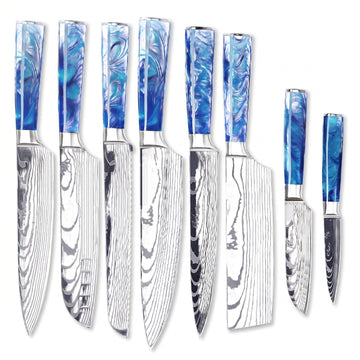
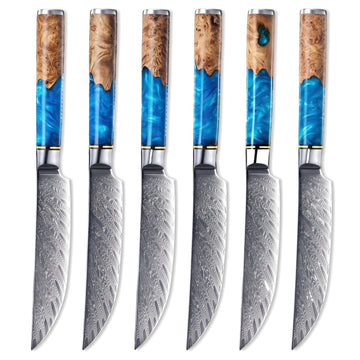
Hand-forged patterns never repeat exactly. If a seller's photos show two knives of a model with the same pattern, line for line, the pattern was copied onto them. Our own spec standard says it plainly: the pattern differs from knife to knife and from the pictures, which are digital renders.
4. Read the listing for the steels
A maker who forge-welds Damascus knows which two steels went into it and says so. "Damascus steel" with no steels named, or a single steel such as 440 stainless named alone, is a warning sign.
5. Weigh the price
Forge-welding, drawing out and etching a billet takes hours of skilled work that a laser does in seconds. A Damascus knife priced like a plain-steel knife of the same size is either not Damascus or not made well.
6. On a knife you own: the spot test
On carbon Damascus, a drop of white vinegar or lemon juice left on a hidden spot of a bright, freshly sharpened bevel for a few minutes darkens unevenly, showing the layers. Wipe it off, rinse, dry and oil the blade afterward. A plain steel blade darkens evenly or not at all.
Checks that tell you nothing
- A magnet. Both steels in carbon Damascus are magnetic, and so is almost every plain knife steel.
- A high layer count. A number such as 500 layers says nothing about how well the bar was welded or how the blade cuts, and nothing stops a fake from printing one. We do not state a layer count, because we publish only what we have measured on each model.
- Weight and sound. A pattern-welded blade weighs and rings the same as a plain one of the same shape.
What a pattern name tells you
Pattern names describe how the bar was worked, not the quality of the steel.
- Random: the layers folded and drawn out, giving a flowing, wood-grain look.
- Twist: the bar twisted while hot, giving repeating curls.
- Ladder: grooves cut or pressed across the bar, giving rungs along the blade.
- Raindrop: dimples drilled or pressed into the bar, giving rings.
- Feather: the bar split and pressed open, giving a mirrored chevron down the middle.
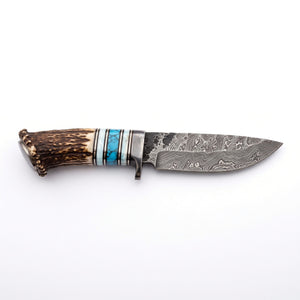
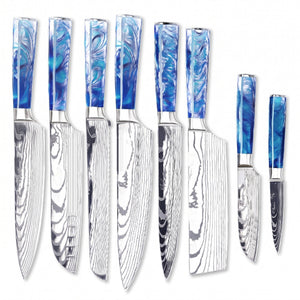
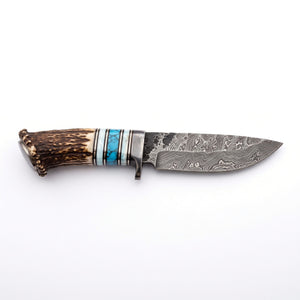
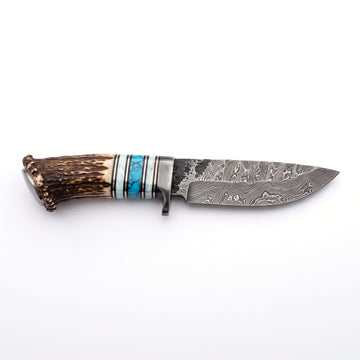
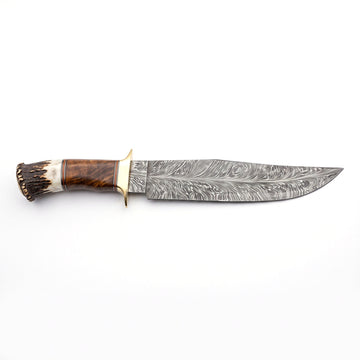
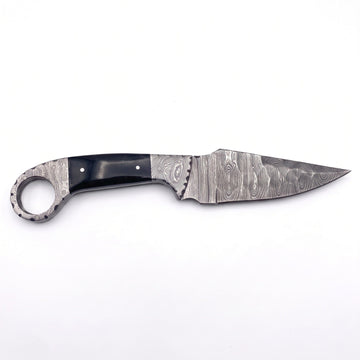
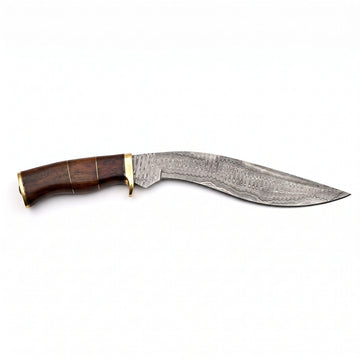
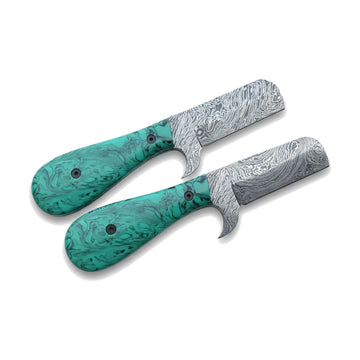
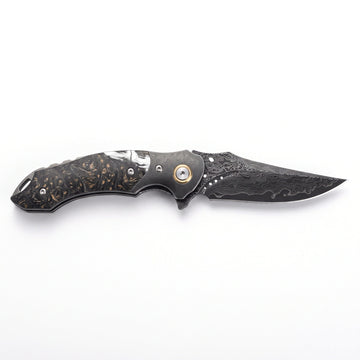
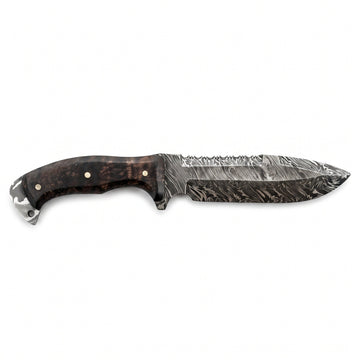
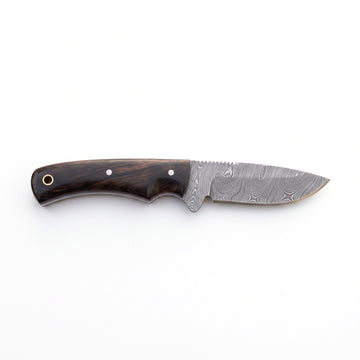
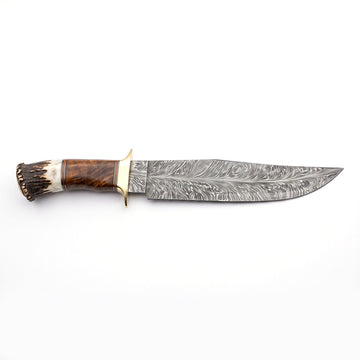
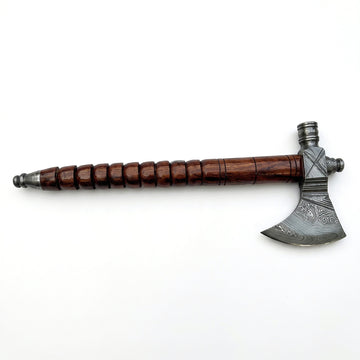
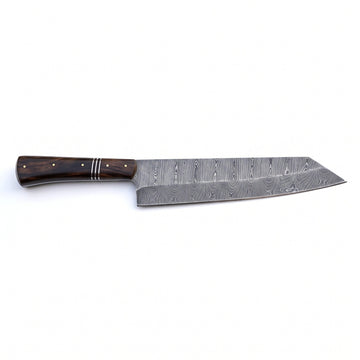
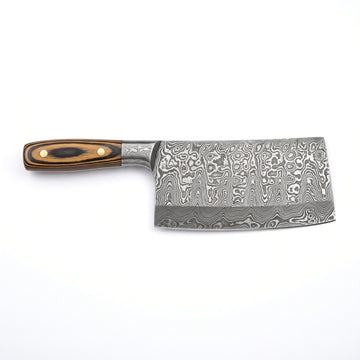
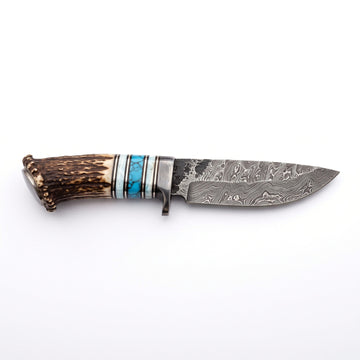
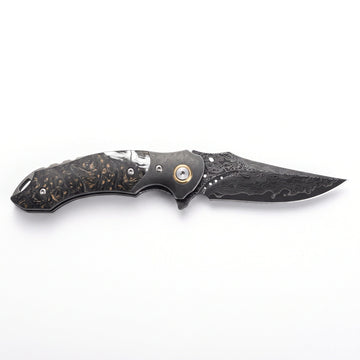
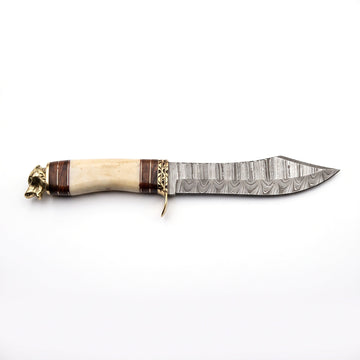
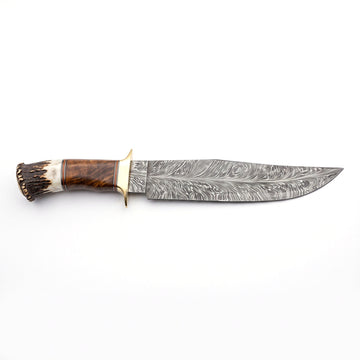
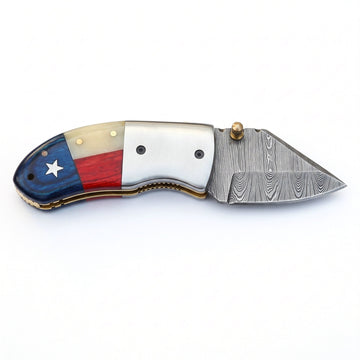
Our product photos show each model. Because every blade is forged by hand, the pattern on the knife you receive differs from the photos in detail.
How Crownridge Damascus is made and listed
Every Crownridge Damascus blade is pattern-welded from 1095 and 15N20 steel, forge-welded into one bar, drawn out and folded, then etched. The pattern runs through the steel, shows on the spine and stays after sharpening. It is never laser-marked or printed on.
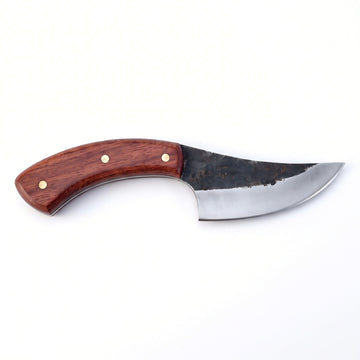
The word "Damascus" appears only on a Damascus knife. Our forged carbon steel, farrier rasp and J2 stainless knives are named for their steel, carry no pattern, etched or otherwise, and are priced as plain steel. Two figures common on other listings, a hardness number (HRC) and a layer count, are missing from ours until we have measured them on each model. The full written standard is on the spec standard, and the people and the process are on our forge.
Real Damascus needs carbon-steel care
Because our Damascus is two carbon steels, it rusts if it is left wet. Dry it after every use, wipe on a thin coat of oil, keep it out of the dishwasher and store it out of its sheath. Never use steel wool, scouring pads or metal polish on the blade: they rub off the etch, and the pattern loses its contrast, though not the layers. The knife care guide covers every step.
Quick answers
Does a real Damascus pattern wear off?
The layers never wear off, because they run through the blade. The etch that gives them contrast is on the surface, so abrasives and sharpening brighten the steel where they touch it; use and a fresh etch bring the contrast back. A printed or laser-marked pattern does wear off, and does not come back.
Is stainless Damascus real Damascus?
Yes, when two stainless steels were forge-welded together. Damascus is a method, not a particular steel.
Is Damascus-clad steel fake?
No. A Damascus-clad blade has real pattern-welded layers over a single-steel core, and the core shows as a bright line along the edge.
Why does real Damascus cost more?
Forge-welding a billet, drawing it out, shaping it and etching it takes hours of a smith's work, and a bad weld means starting again. A plain blade skips all of it.
Is Damascus better than plain steel?
It is not sharper by itself. A well heat-treated plain carbon steel cuts as well. You pay for the pattern, the forging and the way each blade is different; if you want the lowest-maintenance knife, choose J2 stainless.
See the pattern on a forged blade
Browse Damascus hunting knives, Damascus bowie knives, Damascus folding knives, Damascus chef knives and Damascus knife sets.