



How to Slice Brisket Across the Grain
Brisket is two muscles whose fibers run in different directions. Here is how to read each one, how thick to cut it, and what blade length makes the job simple.
How do you slice a brisket?
To slice brisket, let it rest for at least an hour after the cook, split the point from the flat along the fat seam, find the grain in each piece and cut across it with a long, sharp knife. Slice the flat about a pencil thick, which is about a quarter inch, and the point a little thicker.
A whole brisket is two muscles joined by a seam of fat. The flat is lean and even, and the point is fatter and sits on top at one end. The steps run in this order:
- Rest the brisket for at least an hour, wrapped and kept at 140 degrees F or above.
- Find the fat seam and separate the point from the flat.
- Turn each piece so the grain runs side to side in front of you.
- Slice front to back, straight across the fibers, in long smooth strokes.
- Slice only what you will serve, and keep the rest whole.
Four mistakes spoil sliced brisket: cutting it straight off the smoker, cutting with the grain, sawing with a short or dull blade, and slicing the whole brisket before anyone is ready to eat.
Which way does the grain run on a brisket?
On a brisket, the grain of the flat runs lengthwise along the flat, and the grain of the point runs in a different direction from the flat's. Grain is the direction of the muscle fibers. You slice across it, which shortens the fibers in every slice, and short fibers are what make a slice tender. Slice with the grain and you get long strands that chew like string.
The bark hides the fibers after the cook, so read the grain before it goes on the smoker. Look at the cut face of the raw meat, where you will see fine parallel lines. Some cooks trim a small notch from one corner of the flat, along the line they will cut later, as a marker. After the cook you can also tear a small piece from a trimmed edge, because the meat pulls apart along the grain.
Because the two muscles run in different directions, slicing a whole brisket in one direction leaves part of it cut along the grain. That is the reason to cut the point apart from the flat first.
How long should brisket rest before slicing?
Brisket should rest for at least an hour before you slice it, and many pitmasters rest it for two hours or more. Resting lets the juices that moved toward the surface settle back into the meat and lets the fat set, so the slices hold together. Wrap the brisket in butcher paper or foil and keep it in a warm, empty cooler or a low oven.
Whatever the length of the rest, the brisket should stay at 140 degrees F or above until you slice it, which is the hot-holding temperature USDA gives for cooked food. Push a thermometer into the flat after the first hour. If it reads under 140 degrees F, slice and serve, or move the brisket to a warm oven.
How do you separate the flat from the point?
To separate the flat from the point, find the thick seam of fat between the two muscles and cut along it. Hold the point steady with a hand or a carving fork, run the knife tip down the seam and pull the point away, cutting the connective tissue as it shows. The cut follows the fat, so you rarely need to cut into either muscle.
Which is better, the point or the flat? Neither. The flat is leaner and slices into tidy, even slices. The point is fattier and juicier, and it is the part cooks cube for burnt ends. At a barbecue counter, "lean" means flat and "moist" means point.
How thick should you slice brisket?
Slice the flat about a pencil thick, a quarter inch, and the point a little thicker. The table gives common thicknesses by use. They are common barbecue practice, written down on November 6, 2026, and not measurements we took.
| Cut | Thickness | Why |
|---|---|---|
| Flat, for a plate | About 1/4 inch, a pencil | Holds together on a fork and stays tender |
| Flat, for a sandwich | 1/8 to 1/4 inch | Stacks on a bun and bites through cleanly |
| Point, for a plate | 3/8 to 1/2 inch | The fat keeps a thicker slice tender |
| Burnt ends | 1 to 1 1/2 inch cubes | Cubes of the point go back on the heat to crisp |
A very tender brisket falls apart at a pencil thickness. If yours does, cut it 3/8 to 1/2 inch thick and use one long stroke.
What is the best knife for slicing brisket?
The best knife for slicing brisket has a long, sharp blade, because a blade longer than the cut goes through in one smooth pull instead of a saw. Pitmasters usually reach for a slicing knife of 11 to 14 inches, narrow, with a straight, serrated or scalloped edge. A sharp chef or carving knife works when its blade is long enough for the cut.
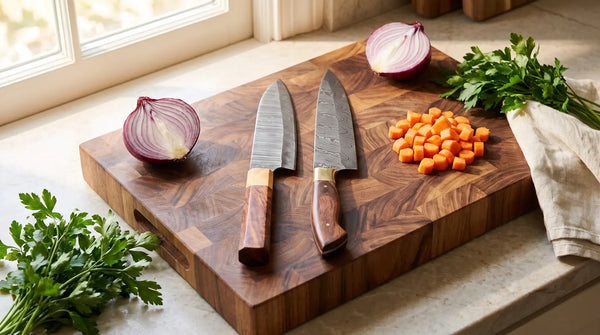
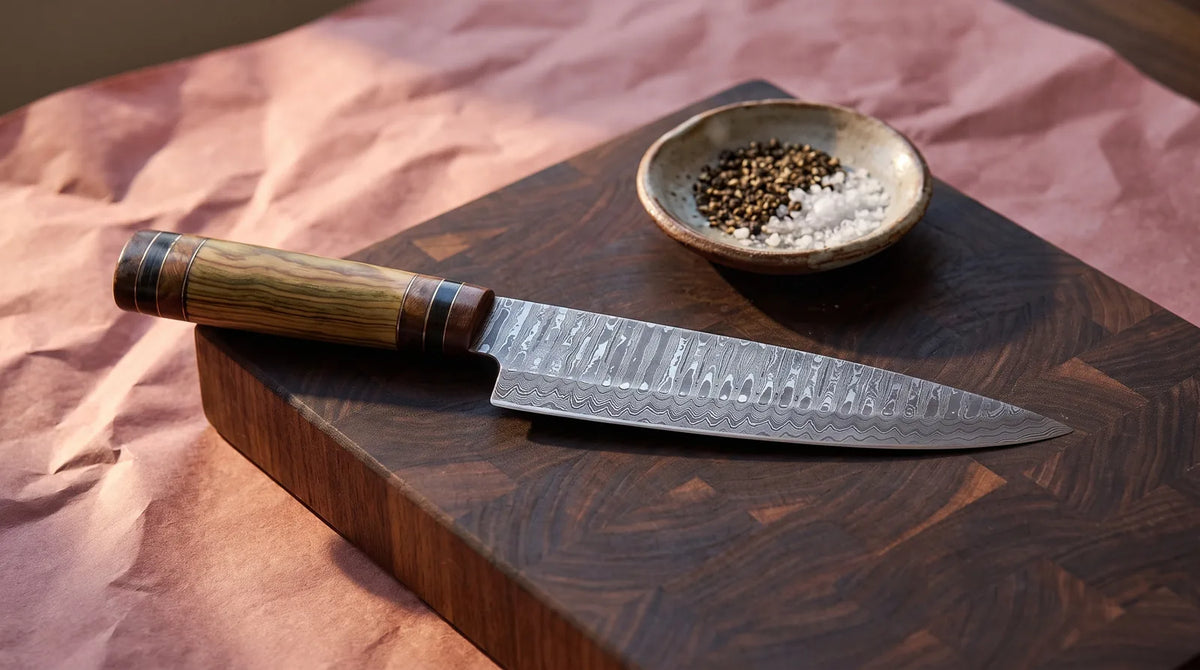
Our 13" Damascus Chef Knife | Olive Pakka Wood has a 13 inch blade and is 18 inches overall. It is pattern-welded Damascus (1095 and 15N20), and it cost $189 on November 6, 2026. A 13 inch blade is the length of a full-size slicer. The length is what the product page records, and it is all we claim about brisket.

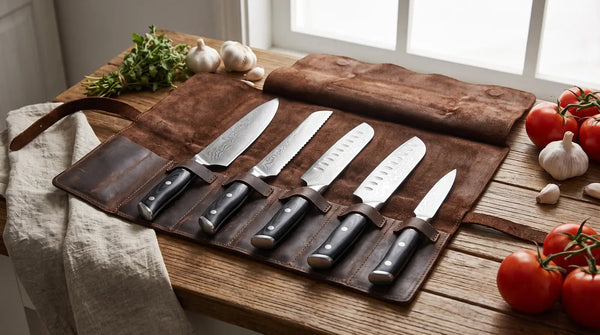
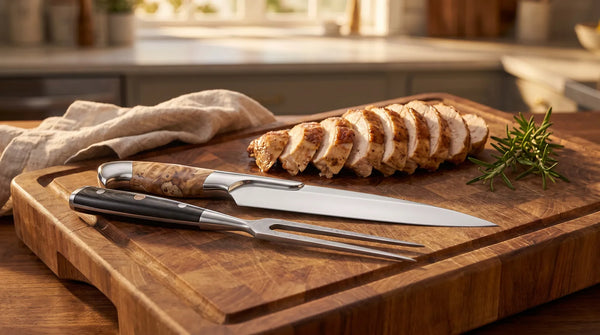
The 13" Satin Steel Carving Knife | Figured Burl has a 9 inch blade and is 13 inches overall, and it cost $109 on November 6, 2026. A 9 inch blade clears a cut up to about 9 inches wide in one pull. A wide point or a thick flat can be wider than that, so halve it first. The Damascus Carving Knife and Fork Set | Micarta is a 2 piece set that comes in one leather knife roll, and it cost $209 on November 6, 2026. The carving knife and the set are in our carving knives collection, and the chef knife is in our chef knives and Damascus chef knives collections.

Salt, rub and brisket juice stay on the blade, so wash it by hand, dry it at once and wipe on a thin film of oil. Our Damascus knives are pattern-welded 1095 and 15N20 and rust if left wet, and our plain knives are carbon steel and rust too. The care guide has the routine. We sell no cutting boards, so slice on a large wood or plastic board with a juice groove. Our guides to the best knife for carving turkey, types of kitchen knives and how to sharpen a knife cover the knife side in more detail.