

What Is a Kukri? Uses, Sizes and Care
A plain guide to the kukri as a camp and yard chopping tool: what each part does, how long the blade should be, and how it compares with a machete, hatchet and bowie.

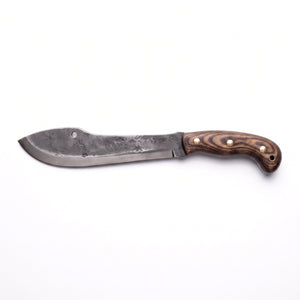
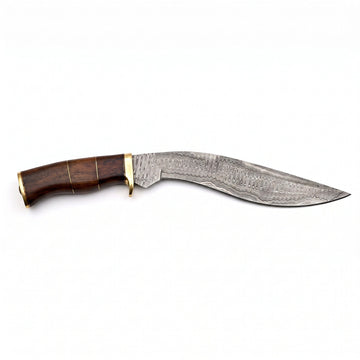
A kukri is a heavy chopping knife with a blade that bends forward, from Nepal, where it has served for centuries as a farm, kitchen and woodland tool. The bend puts the weight ahead of your hand, so a short blade chops like a small hatchet. At camp, a kukri clears brush and splits kindling.
What is a kukri used for?
A kukri is used for chopping: cutting branches and brush, splitting kindling, clearing a camp or a trail, and trimming a yard. The narrow section of blade near the handle handles light work such as notching a stake or cutting cord. Kukris are poor at fine carving and at skinning, where a short, thin-bladed knife does better.
The reason a kukri chops well is leverage. The blade curves forward and widens toward the tip, so most of its mass sits ahead of your grip. Each swing carries more momentum than a straight knife of the same blade length would. You get chopping power without carrying a full-size hatchet.

What are the parts of a kukri?
A kukri has six parts that matter when you pick one: the spine, the belly, the narrow section near the handle, the notch, the handle and the pommel. The table lists what each part does in use.
| Part | Where it is | What it does |
|---|---|---|
| Spine | The thick, unsharpened back of the blade | Carries the weight and the strength for chopping; it is the side you never cut with |
| Belly | The widest, most curved part of the edge | Does the heavy chopping; this is where the blade bites into wood |
| Narrow section | The blade just ahead of the handle | Handles light work such as trimming and cutting cord, close to your hand |
| Notch (cho) | A small cut at the base of the edge, on traditional kukris | Several traditional reasons are given; see the next section |
| Handle | The grip behind the blade | Gives you a firm hold when swinging; ours are hardwood, bone, buffalo horn with brass, or black micarta |
| Pommel | The end of the handle | Stops your hand sliding off the back of the grip |
Why do kukris have a notch?
Nobody can prove a single reason for the notch, called the cho. Several traditional explanations are given: it marks where the edge ends, it stops sharpening at the end of the edge, it lets sap and water run off the blade, and it carries a traditional or symbolic meaning. A kukri works the same with or without one.
We do not make any claim about the notch on our own kukris. Look at the product photos on each page to see the blade you are buying.
What size kukri is best?
The best kukri size depends on the job: an 8 to 10 inch blade suits light camp work, and a 12 to 14 inch blade suits heavy clearing and splitting. A longer blade swings with more force but tires your arm sooner and is harder to control. The table uses blade lengths from our Summit series.
| Summit kukri | Blade length | Overall length | Best job |
|---|---|---|---|
| 12.5" Damascus, bone and brass | 8 in | 12.5 in | Kindling, trimming small branches, a light pack |
| 15" Damascus, buffalo horn and brass, or hardwood and brass | 10 in | 15 in | All-round camp use: kindling, limbing, clearing brush |
| 18" satin steel, hardwood | 11.75 in | 18 in | Brush and branches up to wrist thickness, yard clearing |
| 18" Damascus, hardwood | 12 in | 18 in | The same jobs, in pattern-welded steel |
| 22" satin steel, black micarta | 14 in | 22 in | Heavy clearing and larger branches, where reach and weight matter |
The numbers come from the product records on this store, read on October 8, 2026. The number in each title is the overall length, so the blade is shorter than it.
For most camp work, start with the 15" or the 18". The 22" is a big tool, and you feel it at the end of a long day of swinging.

Which steel and handle should you choose?
Choose Damascus or satin steel by how much you want to pay and how much care you will give the blade. Our Damascus kukris are pattern-welded 1095 and 15N20 steel. They take a good edge and rust if left wet, so you dry and oil them after use. Satin steel is not Damascus, and in the same 18 inch size it costs less: $159 against $189 on October 8, 2026.
Our Summit kukris come with hardwood, hardwood and brass, bone and brass, buffalo horn and brass, or black micarta handles. Micarta is a resin-and-fabric laminate that does not absorb water, so it suits wet camps. Wood, bone and horn look better and want drying after a soaking. Care steps are on the care guide.
Every Summit kukri ships with a Crownridge leather belt sheath cut to the curve of its blade, at no extra cost. The sheath is leather, not Kydex, so keep the knife out of it while the leather is wet. Our kukris do not include the two small side tools some traditional sheaths carry.
How much does a kukri cost?
In our Kukri Knives collection, Damascus kukris run from $129 to $189 and satin steel kukris from $159 to $229, read on October 8, 2026. The shorter the blade, the lower the price in the same steel. Browse the kukri knives collection for the current list.
Kukri vs machete vs hatchet vs bowie: which tool does what?
A kukri sits between a machete and a hatchet: it chops better than a machete because its weight sits forward, and it carries easier than a hatchet. A bowie is a different tool, a straight knife for cutting, not chopping. The table compares the four by shape and job. These are typical ranges for each type, not our product specs.
| Tool | Blade shape | Typical blade length | Best at | Weak at |
|---|---|---|---|---|
| Kukri | Heavy, curved forward, widest near the tip | 8 to 14 in (Summit series) | Chopping branches, splitting kindling, clearing brush | Skinning, fine carving |
| Machete | Long, thin, mostly straight | Often 12 to 24 in | Cutting grass, vines and soft green growth fast | Splitting seasoned wood; thin blades flex |
| Hatchet | Wedge head on a short handle | A head on a handle, not a blade length | Splitting and felling small trees | Fine cutting; you cannot carve with a head |
| Bowie | Straight spine, clip point, a guard | Often 6 to 10 in | General cutting, camp tasks, dressing game | Heavy chopping, which wants more weight forward |
Choose a kukri if you want one tool for chopping and light cutting on the trail. Choose a hatchet if splitting logs is the main job: our hatchet vs axe guide covers when to pick which. Choose a bowie for cutting work, and read what a bowie knife is first. Our Damascus axes and hatchets and Damascus bowie knives are in their own collections.
How do you use a kukri safely?
Use a kukri by chopping with the belly of the blade, gripping firmly and letting the weight do the work. Swing in a clear path with nothing and no one in it. Chop on a block or stump, never toward your own legs, and keep your free hand well behind the swing.
- Clear the space around you of branches, people and pets before you swing.
- Hold the handle in a firm, whole-hand grip, with your hand against the pommel.
- Aim the belly at the cut and let the blade fall; a hard muscle swing tires you and wanders off line.
- Rest the wood on a block, with the cut at a shallow angle, and sheathe the kukri when you stop.
A dull kukri skips off wood and glances, so keep the edge sharp. The how to sharpen a knife guide shows the method.

Are kukris legal in the US?
Owning a kukri is generally legal in the US. Rules for carrying a large fixed blade differ by state and by city, so check your state and local law before you carry one. We give no legal advice here. A kukri kept at camp or in the yard, in its sheath, is the use we write about.
How do you care for a kukri?
Care for a kukri by drying the blade after every use, wiping on a thin coat of oil and storing it dry. Do not store a kukri in a damp sheath, which holds moisture against the steel and starts rust. Pattern-welded Damascus rusts if left wet, so wipe sap and water off any kukri blade at camp.
The care guide has the full routine. If you are buying for someone who already owns plenty of gear, our gifts for hunters who have everything guide lists more ideas, and the camp and bushcraft knives collection holds the rest of our camp range.