


Hatchet vs Axe: What Is the Difference
One hand or two, 12 inches or 36: a plain comparison of handle length, head weight and the camp jobs each tool actually does well, with sizes in between.

A hatchet is a one-handed axe with a 12 to 16 inch handle and a 1 to 3 pound head, built for close, one-hand work at camp. An axe takes two hands, with a 24 to 36 inch handle and a 3 to 6 pound head, built for felling trees and splitting rounds that need more force and reach.
Hatchet vs Axe, Side by Side
| Hatchet | Axe | |
|---|---|---|
| Handle length | 12 to 16 in | 24 to 36 in |
| Head weight | 1 to 3 lb | 3 to 6 lb |
| Grip | One hand | Two hands |
| Best jobs | Kindling, stakes, limbing, game processing | Felling, splitting rounds |
| Carry | On a belt or in a pack | Carried by the head or in a vehicle |
| Safety note | Short swing, keep your off hand well clear of the arc | Full swing, clear space and footing matter more |
What a Hatchet Does Well at Camp
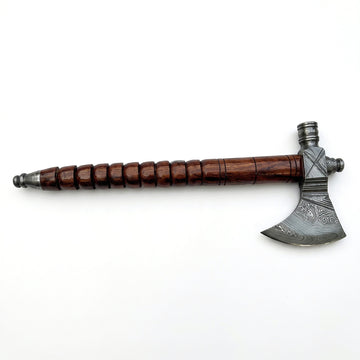
A hatchet earns its space in a pack because it covers the small jobs an axe is clumsy at: splitting kindling down from split firewood, driving and pulling tent stakes with a flat hammer poll if the head has one, limbing branches off a downed log, and breaking down game once the hide is off. All of that is one-hand work at close range, which is exactly what a short handle and a light head are built for. A hatchet is not a knife, and it will not do a knife's fine cutting or skinning work, but it will do the rough splitting and chopping a knife cannot. A compact model like the Hearth 7.5 inch Damascus Camping Hatchet rides easily in a pack side pocket without adding much weight.

When You Want an Axe Instead
Felling a standing tree and splitting rounds into firewood both need the reach and the head weight a hatchet does not have. The longer handle lets a full two-hand swing build up speed before the head arrives, and the heavier head carries that speed into the wood. Trying to fell or split with a one-hand hatchet just means more swings and more risk of the head glancing off the wood instead of biting in. We sell camping hatchets built for one-hand camp work, not full-size felling axes, so if your trip means dropping trees or splitting a winter's worth of rounds, that is a job for a proper axe, not anything in our lineup.
Camp Axe and Boys Axe: the Sizes in Between
Between a hatchet and a full felling axe sit a couple of in-between sizes worth knowing. A boys axe usually runs a 24 to 28 inch handle with a lighter head, sized for someone still building the strength and technique for a full axe, or for lighter splitting at camp. A camp axe sits close to that same range, long enough to swing with two hands but light enough to carry on a pack frame. Both blur the line with a large hatchet, so the handle length and whether a tool is meant for one hand or two matter far more than the name printed on the tag at the hardware store.
How to Choose a Camping Hatchet
Overall length is the first decision: 7 to 8 inches overall is compact enough to ride in a pack side pocket, while 16 to 17 inches gives more reach and chopping power for a base camp you drive to rather than hike into. Steel comes next. Pattern-welded Damascus, ours is forged from 1095 and 15N20, takes a keen edge and shows a pattern after an acid etch; forged carbon steel with a forge scale finish, like the Hearth 16 inch Carbon Steel Camping Hatchet, costs less and cuts just as well. A wood handle, walnut, rosewood or another hardwood, should feel solid in the hand with no play where it meets the head. Look for a leather head mask or cover included, since an exposed hatchet edge in a pack is a liability for everything else in the bag.

Care: Keeping the Head and Handle Sound
Dry the head after every use, since standing moisture on a hatchet's edge and cheeks turns to rust faster than on a thin knife blade because there is more flat steel to catch water. A light coat of oil on the steel before it goes back in its mask or on the wall keeps that surface protected. A wood handle wants its own occasional coat of oil worked into the grain, especially at the point where it meets the head, to stop it drying out and loosening over a season. Touch the edge up with a sharpening puck or a flat file rather than a full grind; a hatchet only needs to be sharp enough to bite into wood, not shave with. Our care guide covers the full routine for both steel and wood. For the background on how a pattern-welded Damascus head is made, see what Damascus steel is.
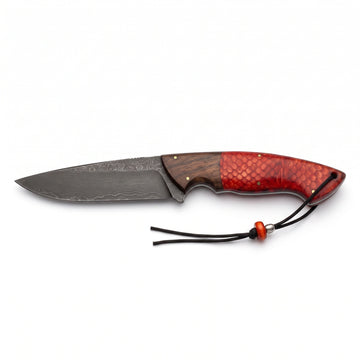
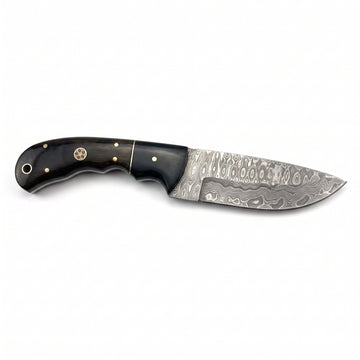
See the full lineup in Damascus axes and hatchets, and the fixed-blade knives that pair with a hatchet at camp in camp and bushcraft knives. A camp knife and a hatchet such as the Hearth 17 inch Damascus Camping Hatchet make a practical pair to give; see gifts for hunters.


