

What Is a Gut Hook For on a Knife?
What the notch on the spine does, how to use it on deer, whether it earns its place on your knife, and how to keep the hook sharp.

A gut hook is a small, sharpened, semicircular notch ground into the spine of a hunting knife. You slide the hook under the hide, edge up, and pull. The hide or belly opens in one line, and the point never touches what lies underneath. The main edge stays untouched and sharp for the work that follows.
How do you use a gut hook, step by step?
You use a gut hook by starting a small opening with the main edge, then switching to the hook for the long cut. The hook does the travelling; the point stays out of the way. Take it slowly and keep the knife angled up, away from the body.
- Make a short starting cut through the hide with the main edge, just long enough to fit the hook.
- Turn the knife so the spine faces down and the hook faces up, toward the hide.
- Slide the hook into the opening until the notch catches the hide.
- Lift the hide slightly away from the body with your off hand, so the hook rides under it.
- Pull the knife toward you in one steady line. Let the hook open the hide as you go instead of pushing down.
The same move works along the legs when you skin. Open the hide with the hook, then switch back to the main edge to work the hide free. A gut hook is for opening, not for slicing meat.

Is a gut hook worth it?
A gut hook is worth it if you open the hide yourself on most animals and want a cleaner first cut. It is not worth it if you want one knife that sharpens in a minute on any stone. The table sets a gut hook knife beside a plain drop point knife of the same size.
| Job | Gut hook knife | Plain drop point |
|---|---|---|
| Opening the belly | Hook lifts the hide and opens it in one pull | Needs two fingers under the blade to guide it |
| Skinning | Hook starts the cuts; the main edge does the rest | Main edge does everything |
| Slicing meat | Same main edge; the hook sits unused on the spine | Same |
| Sharpening | Two edges, and the hook needs a round tool | One edge, any stone or rod |
| Cleaning | Dry the inside of the curve | Wipe the blade and spine |
| Price | Our Ridgeback gut hook knives run from $99 to $129 | Varies by knife |
The comparison above is our own summary of how the two shapes work. The prices come from the product pages as recorded on October 8, 2026.
The honest downside: a gut hook is harder to sharpen than a straight edge, and a hook that goes dull is useless until you fix it. If you dress a deer or two a season, a plain drop point does the job. If you dress several, the hook saves time.
Do you need a gut hook to field dress a deer?
You do not need a gut hook to field dress a deer. A plain drop point works fine if you guide the blade with two fingers and keep the point shallow. A gut hook makes the opening cut easier to control, nothing more.
Can you skin a deer with a gut hook? Yes, for the opening cuts along the legs and belly. The hook is not the tool for separating hide from meat. For that, the main edge of the knife does the work, and a skinning blade with a gentle curve does it best. Our guide to the best knife for skinning a deer covers the blade side of that choice.
Gut hook knife or skinning knife: which one should you carry?
Carry a gut hook knife if you want one blade for opening and skinning. Carry a plain skinning knife if you already have a hook elsewhere or you want the simplest knife to sharpen. A gut hook knife is a skinning knife with one extra notch, so the two overlap more than they differ.
The shape of the main blade matters more than the hook. A drop point gives you a strong tip and a belly for sweeping cuts; our guide to knife blade shapes shows how each profile handles skinning. Browse the Skinning Knives & Gut Hook Knives collection to see both kinds side by side.
How do you sharpen a gut hook?
You sharpen a gut hook with a tapered round tool sized to the curve: a small diamond file, a ceramic rod, or fine sandpaper wrapped around a dowel or pencil. Stones do not fit the curve. Work the hook on its bevel side only, then deburr the flat side with a light pass.
- Choose a rod or dowel that fits inside the curve without rocking.
- Stroke from the inside of the hook outward, matching the angle of the existing bevel.
- Count your strokes so both sides of the curve get the same work.
- Draw the tool once across the flat side to remove the burr.
- Test on a scrap of paper or cord, never by running a finger over it.
We sell no sharpening tools, so use what you own. The hook on each of our gut hook knives is sharpened by hand before it ships, like the main edge. For the main edge, see our guide on how to sharpen a knife.
What size gut hook knife is right for deer and elk?
A blade between 3.5 and 4.5 inches suits most deer work, and a 5 inch blade gives more room on elk. Shorter blades are easier to control close to the body; longer ones reach farther along a big hide. The title number on our knives is the overall length, so the blade is shorter than it reads.
| Knife | Blade | Overall | Handle |
|---|---|---|---|
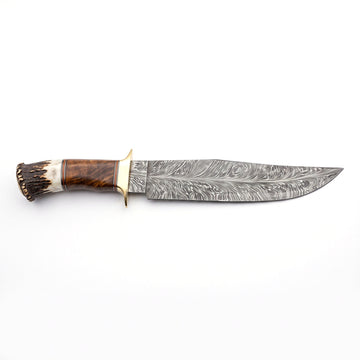
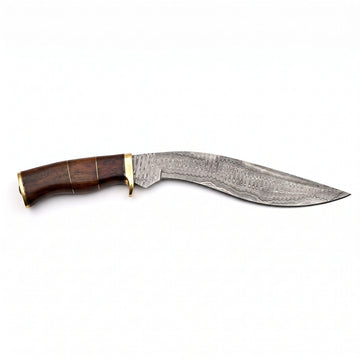
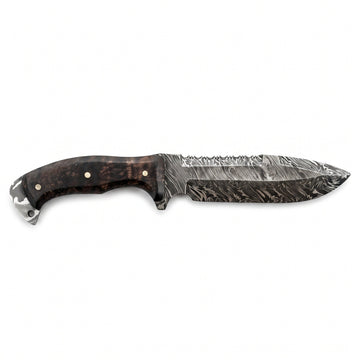
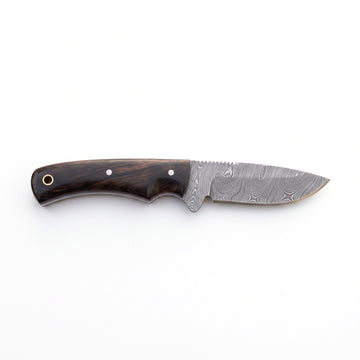
| Ridgeback 7" Damascus Gut Hook Knife | Walnut | 3.5 in | 7 in | Walnut |
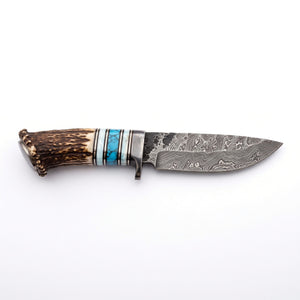
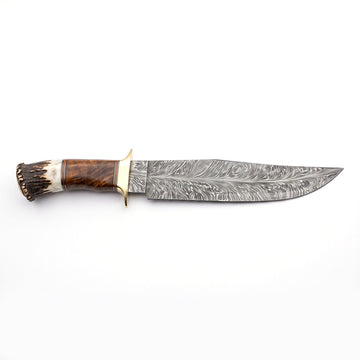
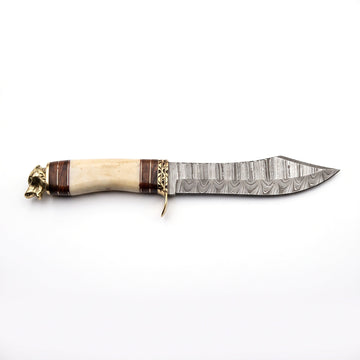
| Ridgeback 8" Damascus Gut Hook Knife | Stag | 4 in | 8 in | Stag |
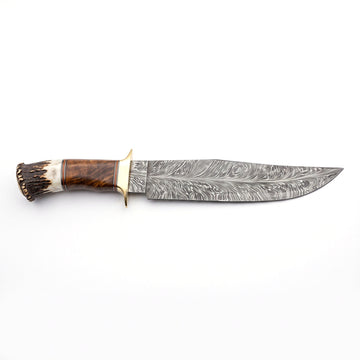
| Ridgeback 9" Damascus Gut Hook Knife | Stag | 4.5 in | 9 in | Stag |
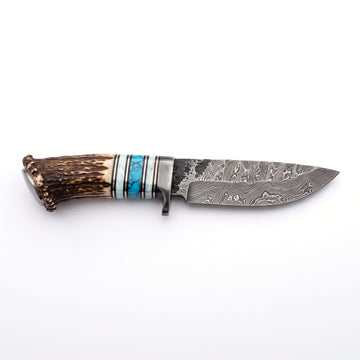
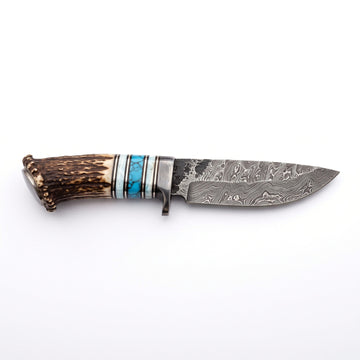
| Ridgeback 10" Damascus Gut Hook Knife | Bone & Turquoise | 5 in | 10 in | Bone |
These figures come from the recorded specs on each product page, checked on October 8, 2026. Each one is pattern-welded Damascus (1095 and 15N20), full tang, with a plain edge and a sharpened gut hook on the spine. Each ships in the Crownridge belt sheath at no extra cost. Our size guide explains how we measure.

How do you care for a gut hook knife after the field?
Care for a gut hook knife by rinsing it, drying it fully and oiling the steel. Damascus is two carbon steels, so it rusts if left wet. The inside of the hook curve holds water and residue longer than a flat edge, so dry it with a twisted corner of a cloth.
- Rinse with cool water, then dry the blade, the spine and the inside curve of the hook.
- Wipe a thin film of oil over the steel before it goes back in the sheath.
- Let the leather sheath dry out on its own; never store a damp knife in it.
Our care guide has the full routine. A leather sheath holds moisture; we make leather sheaths only, so in a wet season dry the knife and the sheath separately.
What else does a hunter carry besides a gut hook knife?
Many hunters carry a main knife and a backup for small jobs. Our hunting knife guide explains how to pick the main one. If you are buying for someone else, the gifts for hunters collection groups knives by handle and price, and the Damascus hunting knives collection has the wider range, including a few with a gut hook.